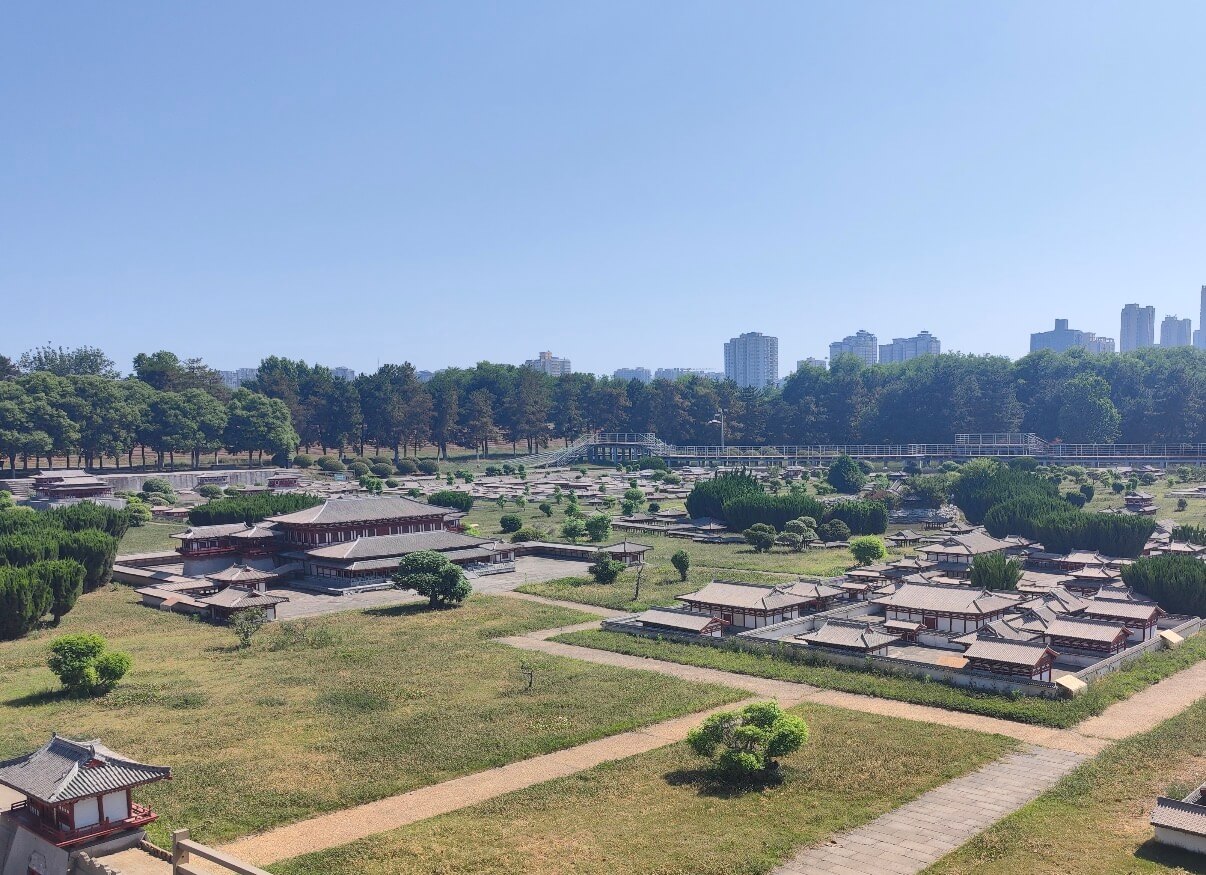
Quick Guide
Introduction
If you are traveling to Xi'an and planning to visit Daming Palace, there is one critical thing you must know first: Daming Palace is NOT a Ming Dynasty building.
The name "Daming" (大明) causes confusion for many foreign visitors. "Da Ming" literally means "Great Brilliance" — and yes, the Ming Dynasty (1368–1644) also used this term. But the Daming Palace in Xi'an was built 734 years before the Ming Dynasty even existed. It is a Tang Dynasty imperial palace, constructed in 634 AD during the reign of Emperor Taizong, the second emperor of the Tang Dynasty.

This article will clear up the confusion, explain why Daming Palace matters, and help you understand what you will actually see when you visit the ruins site today.
1. Why Daming Palace Is NOT a Ming Dynasty Building
Quick Fact: The Name vs. the Dynasty
The character "明" (ming / brilliance) in "Daming" is just part of the palace's name, not a dynasty label. Throughout Chinese history, many buildings, temples, and institutions used the character "明" in their names — it was a word with positive connotations meaning "bright," "brilliant," or "enlightened."
The Ming Dynasty (明朝) happened to choose the same character for its imperial title hundreds of years later. This is a coincidence, not a connection.
Timeline Comparison
| Event | Year | Dynasty |
|---|---|---|
| Tang Dynasty Founded | 618 AD | Tang |
| Daming Palace Construction Started | 634 AD | Tang |
| Daming Palace Destroyed | 904 AD | Late Tang |
| Ming Dynasty Founded | 1368 AD | Ming |
Daming Palace was built 734 years before the Ming Dynasty was founded. Seeing the character "明" in a name does not automatically mean the building belongs to the Ming Dynasty. Always check the construction date to determine the actual dynasty.
2. Timeline: Daming Palace History
Daming Palace was not just a residence for emperors — it was the political, ritual, and cultural heart of the Tang Dynasty at its peak. Here is the key timeline of its history:
Construction Begins
Emperor Taizong of Tang orders the construction of Daming Palace as a summer resort palace for his retired father, Emperor Gaozu. The location is chosen for its natural beauty, near the Taiye Pool.
Becomes Imperial Seat
The palace is expanded and becomes the primary imperial residence and administrative center. From this point, it serves as the Tang Dynasty's main power base.
Empress Wu Zetian Era
Wu Zetian, China's only female emperor, rules from Daming Palace. She further expands the complex and makes it a center of political innovation and cultural flourishing.
An Lushan Rebellion
The devastating An Lushan Rebellion severely damages the palace and the Tang Dynasty begins its long decline. The palace is partially restored but never regains its former glory.
Destruction
Daming Palace is destroyed during the political chaos at the end of the Tang Dynasty. The wooden structures burn down, leaving only the rammed-earth foundations and stone column bases.
In total, Daming Palace served 17 Tang emperors over approximately 270 years — making it one of the longest-serving imperial palaces in Chinese history.
3. Palace Layout: The Largest Palace Complex in Chinese History
Daming Palace was enormous — covering approximately 3.2 square kilometers (790 acres). For comparison, the Forbidden City in Beijing covers about 0.72 square kilometers. Daming Palace was more than four times larger.
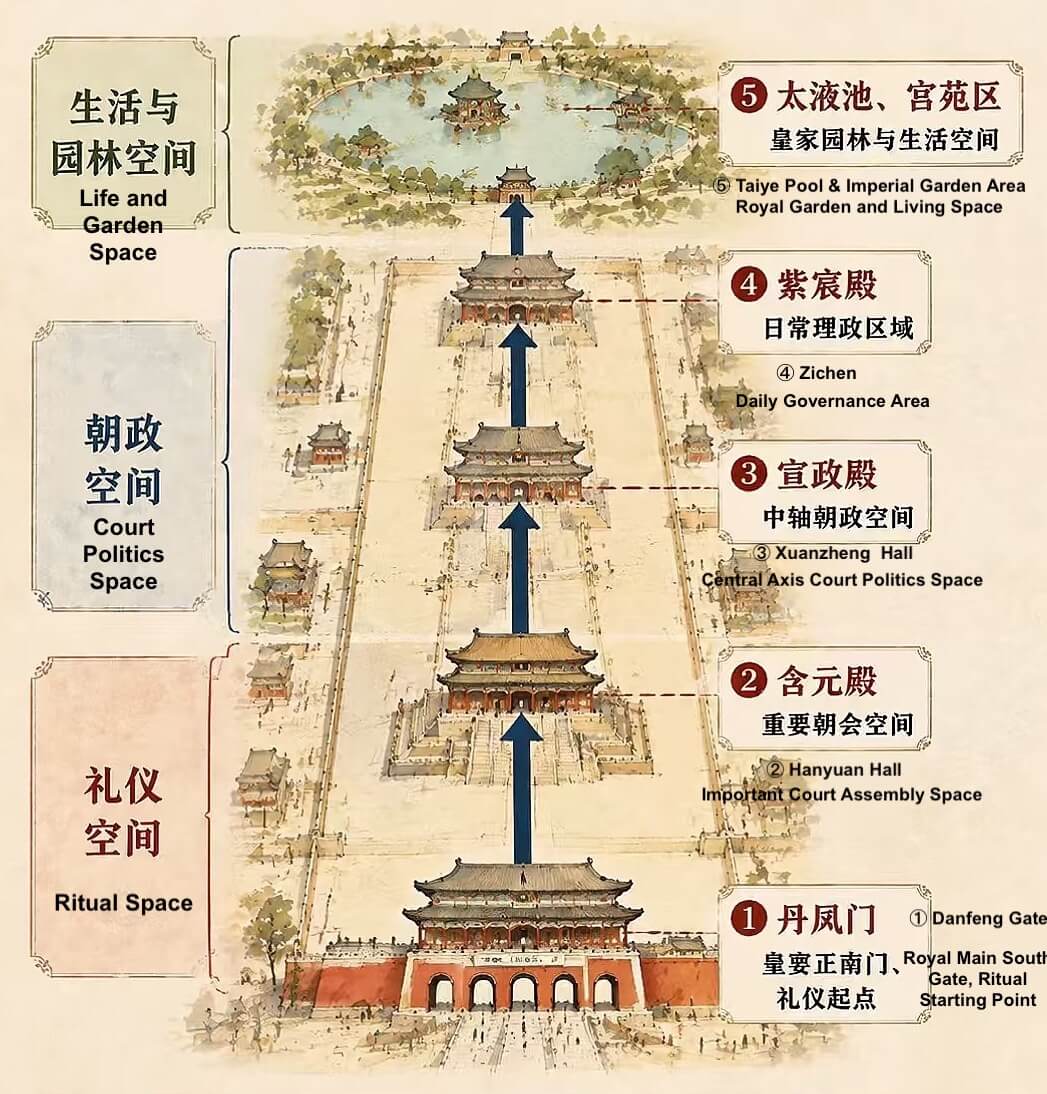
The palace was divided into three main functional areas, arranged along a central north-south axis:
朝区 — The Court Zone (Chaoqu)
The southern section, where official ceremonies, court sessions, and imperial audiences took place.
- • Danfeng Gate — main southern entrance
- • Hanyuan Hall — grand ceremonial hall
- • Xuanzheng Hall — central court hall
- • Zichen Hall — inner administrative hall
寝区 — The Living Zone (Qinqu)
The middle section, where the emperor, empress, and concubines lived and handled daily affairs.
- • Imperial bedrooms and living quarters
- • Study and private audiences
- • Government offices for daily administration
- • Service buildings for the imperial household
后苑 — The Garden Zone (Houyuan)
The northern section, a vast imperial garden with lakes, pavilions, and pleasure grounds.
- • Taiye Pool — central water feature
- • Pavilions, terraces, and towers
- • Space for banquets, festivals, and relaxation
- • A place of retreat from court politics
4. The Central Axis: Reading the Palace Layout
To understand Daming Palace, you must understand its central north-south axis. If you visit the ruins park today, keep this axis in mind — it will help you navigate the archaeological site and visualize the palace as it once was.
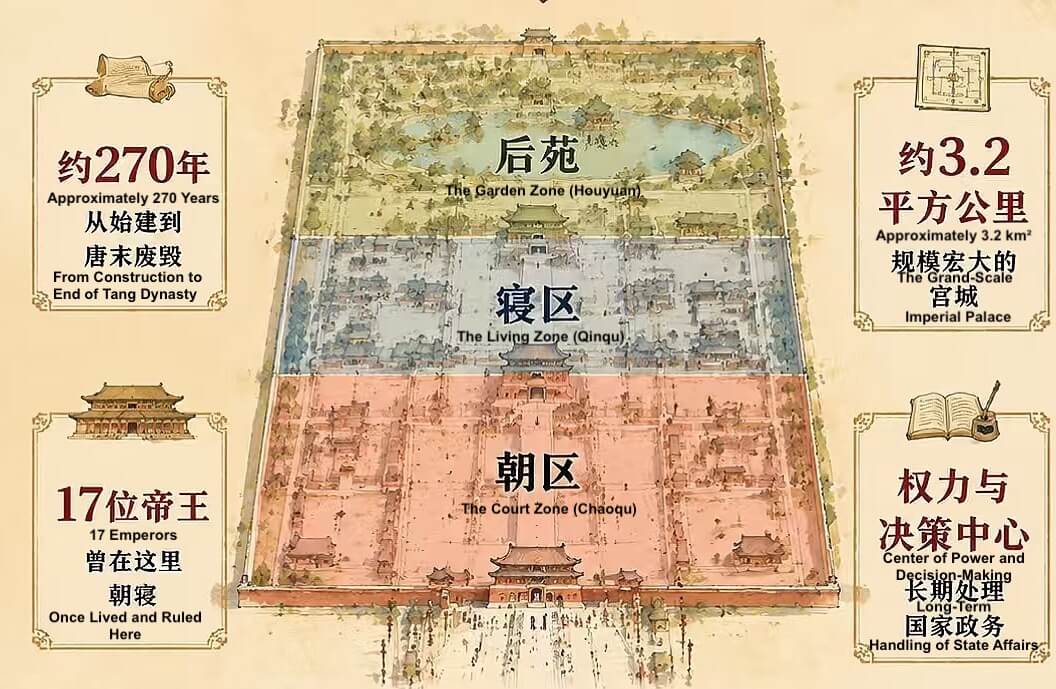
Danfeng Gate (丹凤门) — The Grand Southern Entrance
The main gate of Daming Palace and the formal entry point for all imperial processions. Today, a partially reconstructed version stands at the site, giving you a sense of its original grandeur.
Hanyuan Hall (含元殿) — The Ceremonial Heart
The grandest hall in Daming Palace, where major court ceremonies, imperial audiences, and diplomatic receptions took place. It stood on a massive rammed-earth platform, making it visible from kilometers away.
Xuanzheng Hall (宣政殿) — The Political Center
The main hall for regular court sessions and day-to-day imperial governance. This was where the emperor met with officials and made policy decisions.
Zichen Hall (紫宸殿) — The Inner Sanctum
The most intimate of the main halls, used for private audiences and meetings with close advisors. It was part of the living zone, closer to the emperor's personal quarters.
Taiye Pool (太液池) — The Imperial Garden
A grand artificial lake in the northern garden zone, surrounded by pavilions and terraces. This was where the emperor and court would relax, hold banquets, and celebrate festivals.
Reading the axis from south to north: Ceremony → Politics → Privacy → Leisure. The layout reflects the very structure of imperial power in Tang Dynasty China — public grandeur at the front, privacy and daily life in the middle, and personal retreat at the back.
5. What You See Today: The Ruins Are the Point
When you visit Daming Palace today, you will not see a complete, reconstructed imperial palace. Most of the original wooden structures were destroyed in 904 AD and have not been (and should not be) fully rebuilt. But that is exactly what makes this site special.
Important Note for Visitors
Seeing a partially reconstructed Danfeng Gate or some column bases does not mean that the original Tang Dynasty wooden palace has been fully preserved. Unlike the Forbidden City (whose structures survive), Daming Palace's wood architecture was lost over 1,100 years ago. What you see today is an archaeological site — and that is precisely its historical value.
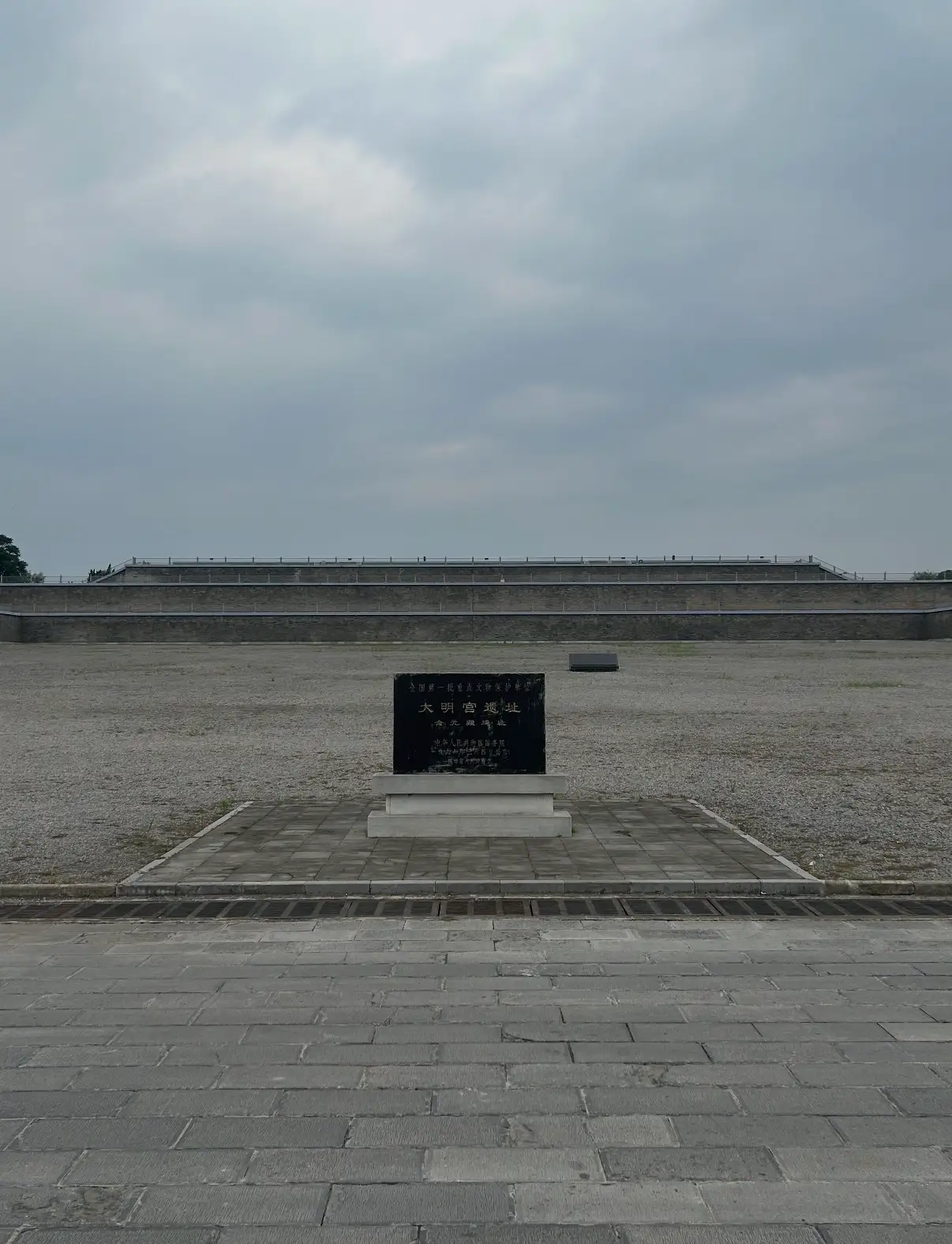
Four Things to Look For
Rammed-Earth Foundations
The massive earthen platforms that supported the grand halls. These are the "bones" of the palace — still standing after 1,300 years. Look closely and you can see the layered construction technique used by Tang Dynasty engineers.
Stone Column Bases
The carved stone pedestals that once supported the wooden columns of the palace halls. These are some of the most tangible remaining artifacts — each one was precisely carved to bear the weight of a multi-story timber structure.
Digital Reconstructions and Models
The on-site museum uses digital technology and physical models to show you exactly how the palace looked during its Tang Dynasty prime. This is where you can see the full glory — without disturbing the actual archaeological remains.
The Overall Spatial Layout
Stand at Danfeng Gate and look north — you can follow the central axis with your mind's eye. The distance and alignment of the foundations reveal the original scale and symmetry of this grand imperial complex.
The Daming Palace Archaeological Site Park is not about seeing a "newly-built" fake palace. It is about seeing what actually remains — the real foundations of one of the greatest imperial palaces in human history. The ruins, combined with digital interpretation, let you reconstruct a mental picture of Tang Dynasty imperial power at its peak.
6. Visitor Guide: Practical Tips for Daming Palace
Opening Hours
- • Peak Season (March–November): 8:30 AM – 6:00 PM
- • Off-Season (December–February): 8:30 AM – 5:30 PM
- • Ticket sales stop 1 hour before closing
Tickets
- • Adults: ¥60 per person
- • Audio guide: Recommended for the full experience
- • Online booking available via the official site
How to Get There
- • Subway: Line 2 to Daminggong Station, Exit D
- • Bus: Routes 2, 26, 47, 104, 209, 214, 216, 263, 309, 409, 703
- • Taxi: Ask for "Daminggong" or "Daming Palace"
Best Time to Visit
- • Early morning (8:30–10:30): Fewer crowds, better light for photos
- • Avoid weekends if possible, especially in peak season
- • Allow at least 2–3 hours for a thorough visit
Plan Your Xi'an Trip
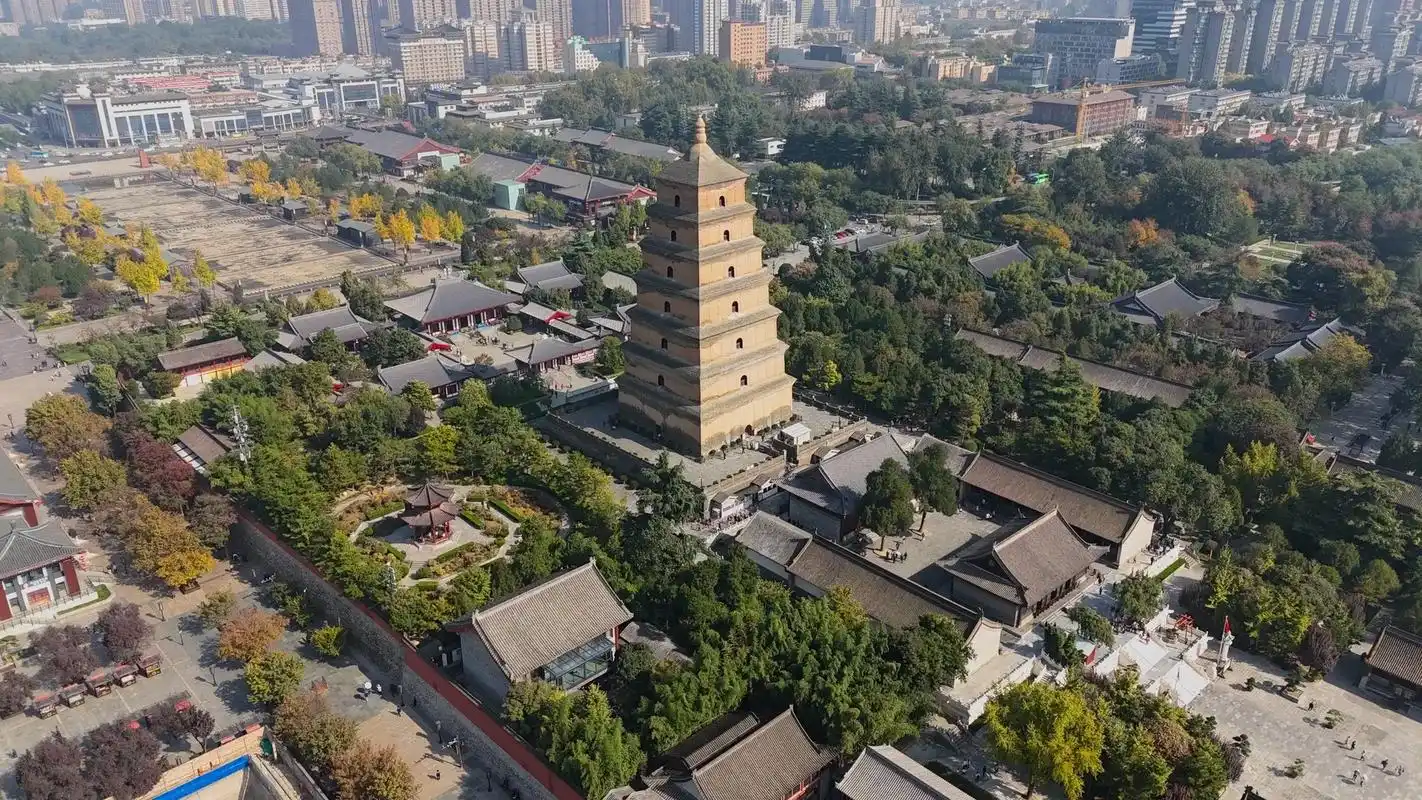
Daming Palace pairs well with a visit to the Terracotta Army, the Ancient City Wall, or the Big Wild Goose Pagoda. For a full day of Tang Dynasty history, combine Daming Palace with the Great Tang All Day Mall entertainment show.
Final Conclusion
Daming Palace is not a Ming Dynasty palace — it is a Tang Dynasty imperial complex built in 634 AD, the largest palace in Chinese history, and one of the most important archaeological sites for understanding Tang Dynasty China.
-
•
Built in 634 AD, 734 years before the Ming Dynasty, making it definitively a Tang Dynasty site
-
•
Served 17 Tang emperors for 270 years as the political and cultural heart of the empire
-
•
At 3.2 square kilometers, it was the largest palace complex in Chinese history
-
•
Today's ruins site lets you trace the imperial axis and understand how Tang Dynasty power was organized
Next time someone tells you Daming Palace is a Ming Dynasty building — you'll know the truth. It's a Tang Dynasty site where the full story of China's golden age unfolds across a 1,300-year-old landscape of foundations, history, and imperial ambition.
FAQ About Daming Palace Xi'an
Q: Is Daming Palace a Ming Dynasty building?
A: No. Daming Palace was built in 634 AD during the Tang Dynasty — 734 years before the Ming Dynasty was founded in 1368 AD. Despite the character "明" in its name, it is purely a Tang Dynasty site.
Q: When was Daming Palace built and destroyed?
A: Construction began in 634 AD under Emperor Taizong of Tang. The palace served as the imperial seat for 17 Tang emperors over about 270 years, and was destroyed in 904 AD during political upheaval at the end of the dynasty.
Q: How large was Daming Palace?
A: Daming Palace covered approximately 3.2 square kilometers (790 acres), making it the largest palace complex in Chinese history. It was over four times larger than Beijing's Forbidden City.
Q: What will I see at Daming Palace today?
A: You will see the archaeological ruins — rammed-earth foundations, stone column bases, and a partially reconstructed Danfeng Gate. The on-site museum offers digital reconstructions and models showing how the palace looked in its Tang Dynasty heyday.
Q: How do I get to Daming Palace in Xi'an?
A: The easiest way is taking Xi'an Subway Line 2 to Daminggong Station (Exit D). You can also take buses (Routes 2, 26, 47, 104, etc.) or a taxi.
Q: Why is Daming Palace important?
A: Daming Palace is the key site for understanding the Tang Dynasty — China's most cosmopolitan and historically significant imperial dynasty. It shows how a medieval empire was governed, ritually organized, and culturally expressed. It is also a UNESCO World Heritage Site as part of the Silk Road.
Q: How much time should I allow for a visit?
A: Plan at least 2–3 hours for a thorough visit. This includes walking along the central axis, visiting the archaeological exhibition hall, and using the audio guide to understand the site's history.
Combine Daming Palace with Tang Xi'an
For a full Tang Dynasty experience, pair Daming Palace with the Terracotta Army (Emperor Qin's tomb complex, contemporary with the early Han Dynasty but geographically related) or the Big Wild Goose Pagoda. After exploring the ruins, enjoy the Tang Dynasty evening show at Chang'an City. Contact us for a personalized Xi'an itinerary.
Share this article:
Link copied to clipboard!
No comments yet. Be the first to share your thoughts!