Quick Guide
Introduction
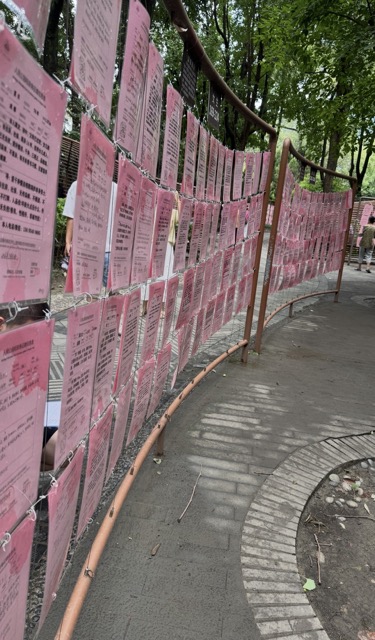
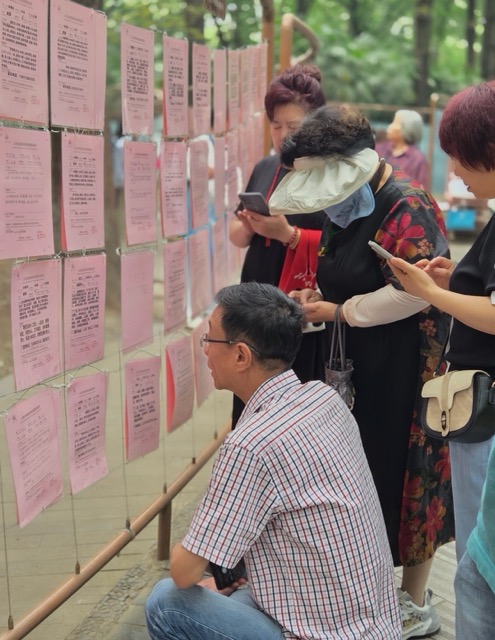
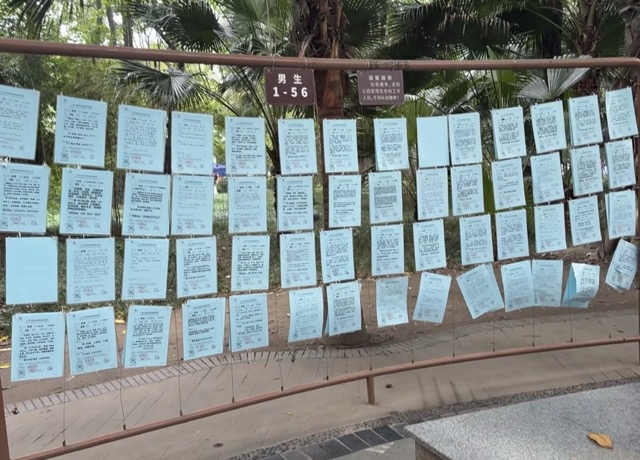
On a weekend afternoon in Chengdu, the trees of People's Park disappear behind a curtain of paper. Hundreds of A4 profiles — some handwritten, most printed — sway from strings tied between branches. Pink cards sit on one line, blue on another. Between them stand mothers and fathers in their fifties and sixties, reading the way other people read the news: quickly, closely, and with a pen in hand.
This is 相亲角 (xiāngqīn jiǎo), the "matchmaking corner" — the closest thing China has to a literal marriage market. It is not a show for tourists, and it is not a singles party. It is a weekly ritual in which families put their children's most measurable qualities on public display and hope that another family will recognise a good match.
Weekends
Saturday and Sunday afternoons, weather permitting
Free
No ticket, no booking — it is simply a corner of the park
Hundreds
Of profiles on an ordinary weekend, sometimes more
Before you go
This is a real family space, not an attraction built for visitors. People are discussing their children's futures, and the phone numbers on those cards belong to real people. Treat the corner as you would a neighbour's living room: look, listen, ask before you photograph, and leave the cards exactly where they are.
1. A Sunday Institution in the Middle of the City
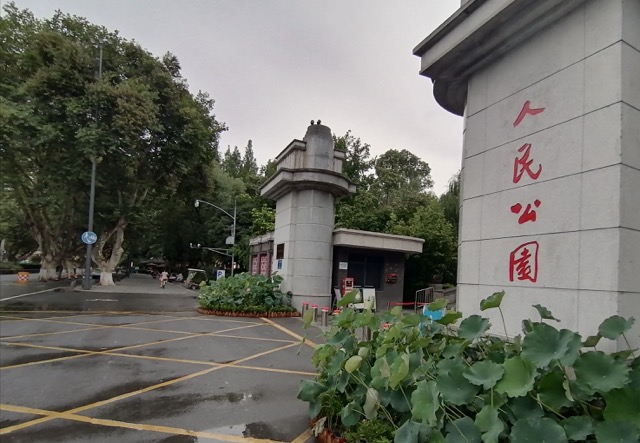
People's Park (人民公园) is Chengdu's oldest public garden and one of its most comfortable places to do nothing. Old men play cards under the camphor trees, aunties practise dance routines by the lake, and the teahouses are loud with the click of covered bowls. The marriage corner occupies a shaded stretch of path inside the park, and on weekends the crowd announces itself before you see it: a low murmur of numbers, ages and school names.
The tradition is usually described as growing organically since the 2000s. It was never planned by the city, and it has no official stage or microphone. Parents simply began meeting in the same place to compare notes, and the corner became a fixture. Today it runs on the same logic as any good market: regular opening hours, repeat visitors, and a shared understanding of what is being traded.
It has also become a stop on Chengdu's informal tourist circuit. Foreign visitors, domestic travellers and photography students wander through with wide eyes. The parents mostly ignore them — unless a friendly foreigner asks a question, in which case the answer may be longer and more detailed than expected.
2. What the Marriage Corner Actually Is
Strip away the crowd and the corner is a simple mechanism: a public noticeboard for private family business. There are no staff, no registration desk and no algorithm. The infrastructure is string, plastic sleeves and parents with time on their hands.
- Parent-run. The people doing the browsing are usually the parents or grandparents of the person described on the card. The candidate is often not there.
- Marriage-first. This is not a place for casual dating. Almost everyone involved is screening for a serious, marriage-oriented introduction.
- Offline and face-to-face. Contact begins with a conversation between two parents, then a phone call or a WeChat exchange, then a meeting between the adult children.
- Free and informal. There is no fee to hang a card or read the wall, though paid matchmaking agencies sometimes hover at the edges.
- Recurring. The same families return week after week, updating a detail, replacing a photo, or widening a requirement.
In other words, it is a screening market, not a speed-dating event. The work being done here is administrative: collecting, comparing, shortlisting and following up. Romance, if it happens, comes later.
3. Marriage Market vs Dating Apps
The obvious comparison is a modern matchmaking app. Both claim to introduce strangers with marriage potential, but they are solving different problems for different people. One is run by families and screens hard facts; the other is run by individuals and screens for feeling.
| Dimension | Marriage corner (相亲角) | Dating app |
|---|---|---|
| Who drives it | Parents and grandparents, acting for their adult child | The individual, who registers, swipes and replies alone |
| What is screened first | Birth year, height, income, property, hukou, degree | Photos, chat chemistry, hobbies and first impressions |
| End goal | Marriage, ideally within a clear timeline | Dating, friendship or something lighter; marriage optional |
| Deal-breakers | No flat or car, modest income, height below a threshold, age above a threshold | Rarely a formal checklist; compatibility is felt rather than scored |
| Typical age | Late 20s to early 40s, with little tolerance around the edges | From 20 upward, across a much wider range |
| How contact starts | A parent-to-parent chat, then a phone call or WeChat | An in-app match, then a message, then a date |
| Cultural logic | Marriage is a family project; stability comes before butterflies | Marriage is a personal choice; experience and attraction come first |
Neither system is more "honest" than the other. The app hides its criteria inside an algorithm and a photo grid. The corner puts them on paper, in public, where anyone can read them. What changes is not the amount of judgement, but who is allowed to do the judging — and whether the person being judged is in the room.
4. The People Behind the Cards
The corner is dominated by a very specific demographic: retired or semi-retired parents, mostly in their fifties and sixties, often mothers, and increasingly grandparents. They arrive with folders, reading glasses, a bottle of tea and a phone that will not stop ringing. Some carry a notebook in which they record the promising numbers they have collected that day.
Their motivations are not mysterious. Many are only children raising only children, in a city where housing is expensive and a secure retirement depends on family. They worry that their child works too hard to date, that the pool has shrunk after 30, or that a good match will be "taken" while nobody is paying attention. The corner is their attempt to be useful.
The adult children are a more complicated presence. Some know exactly what their parents are doing and have supplied the details. Some have been persuaded. Some are vaguely aware and prefer not to think about it. A few turn up quietly on their own to see what the market says about them — which is, for a visitor, one of the more poignant sights in Chengdu.
"Born in 1992, 165 centimetres, master's degree, state-owned enterprise, Chengdu hukou — does your son have a flat?" The sentences are short, practical and strangely intimate, as if a résumé had learned to ask questions.
5. Reading the Cards: Pink, Blue and Painfully Specific
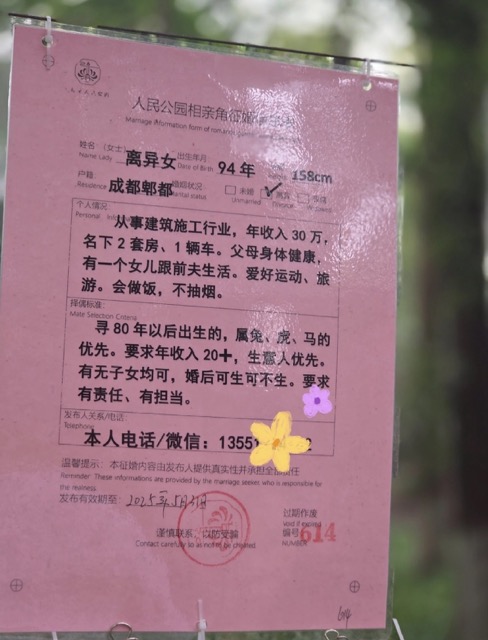
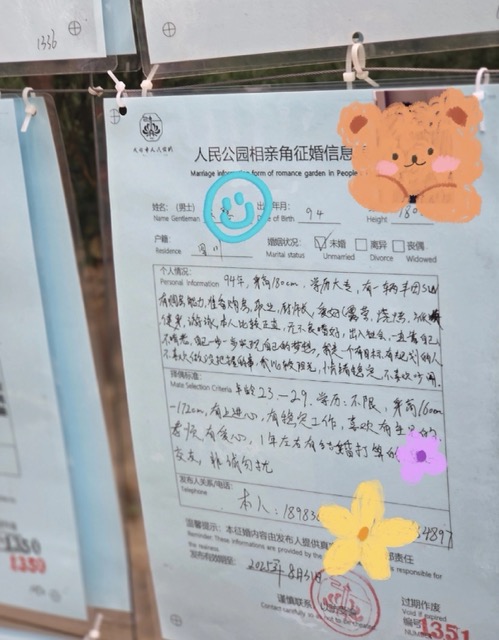
The most photographed detail is the colour code. Pink cards generally describe women, blue cards describe men, and the split lets a parent scan the wall in seconds. A card is usually one A4 page in a plastic sleeve, punched and tied to a line with string or a clip.
The information follows a rough template: birth year (sometimes the exact date), height and weight, education, employer and income range, property status, hukou, personality in three or four adjectives, and a short list of requirements. At the bottom sits the parent's phone number or a WeChat QR code. Photos are optional; when present, they are usually a posed studio portrait.
Born 1994 · 163 cm · master's degree · design institute · Chengdu hukou
Looking for: born after 1990, at least 175 cm, stable work, no smoking.
Born 1991 · 178 cm · bachelor's degree · engineer · flat in Tianfu New Area
Looking for: born after 1993, steady job, family-oriented, willing to live in Chengdu.
Composite examples based on the kind of information commonly displayed. They are not real profiles.
Education is the clearest example of how the market has shifted. A bachelor's degree is now the baseline rather than a bonus; master's degrees are common, and overseas qualifications appear often enough to be unremarkable. Among women's profiles in particular, the credentials on display can be intimidating: good schools, serious jobs, fluent English, a flat already bought.
The result is a strange contrast. The cards are public, but the people they describe are protected behind a parent. The data is intimate — income, housing, family background — yet it is displayed to strangers on a park path. That tension is the reason the corner is so fascinating, and the reason it deserves a little care from anyone holding a camera.
6. The Unwritten "Market Rate"
Regulars will tell you, without much prompting, what the corner is looking for. The standards are direct and unapologetically measurable, and they vary by family, by age and by how long the search has already run.
- For men: height is a visible filter. Being under about 168 cm is often described as a disadvantage, as is having no car or flat, a modest income, or a job without stability.
- For women: age is the sharpest filter. Profiles for women over 36 are fewer, and being from outside Chengdu — or not yet settled in the city — can narrow the field further.
- Education: a bachelor's degree is treated as basic, a master's as normal, and an overseas degree as a small plus rather than a novelty.
- Housing and hukou: a flat in Chengdu, and local household registration, carry real weight because they connect to schools, medical access and long-term stability.
- Small preferences: some families state plainly that they do not want a partner who keeps pets; others list smoking, height, or a preferred zodiac sign.
- The 彩礼 question: visitors report that raising 彩礼 (bride price) too early, or too bluntly, can end a conversation on the spot. Many Chengdu families treat it as a sensitive, old-fashioned topic.
Read this as observation, not advice
These are patterns reported by visitors and regulars, not official rules, and they are not a verdict on any individual. Families differ widely, standards change, and plenty of profiles emphasise kindness, humour or shared interests over centimetres and square metres. If you are reading this as a potential candidate, remember that a public checklist is a starting filter, not a definition of your worth.
The harshness has a context. Chengdu's housing prices have climbed, a hukou still shapes access to public services, and many of these parents grew up in an era when marriage was explicitly a family arrangement. Add the one-child legacy — one family, one child, one shot at a conventional future — and the intensity starts to make sense. The corner is not a random collection of fussy people. It is a pressure gauge for housing, education, welfare and filial duty, all read aloud in a park.
7. How to Visit Respectfully
Visiting is easy; visiting well takes a little awareness. The corner is public, but the information on display is not. A few practical notes will keep you comfortable and keep the families comfortable too.
The practical basics
Where
Inside People's Park (人民公园), central Chengdu. Take Metro Line 2 to People's Park Station (人民公园站) and follow the crowds toward the shaded paths.
When
Saturday and Sunday afternoons, roughly 1–5 pm. The wall is busiest around 2–4 pm. Weekdays are usually empty.
Cost and time
Free. Allow 30–60 minutes, more if you stop for tea in the park.
Language
Little English is spoken. A translation app helps, and numbers, ages and school names are usually legible on the cards.
Seven rules for a good visit
Ask before photographing people. A wide shot of the card wall is usually fine; a close-up of a parent's face is not.
Never photograph phone numbers or QR codes. Those belong to real families, and publishing them online can cause real harm.
Do not touch, move or take the cards. The wall is someone's filing cabinet, not a souvenir rack.
Do not pretend to be a candidate or a relative. Jokes about "looking for a wife" land badly in a place where people are genuinely searching.
Do not interview parents without permission. A short, friendly question is fine. A recorded Q&A is not.
Keep your voice down and your opinions to yourself. Laughing at a height requirement or an age limit is like laughing at someone's family album.
Ignore the paid matchmakers. The public corner is free. If someone tries to sell you a "guaranteed" introduction, walk on.
If a parent approaches you — and some will, out of curiosity — a smile and "谢谢,我只是看看" (xièxie, wǒ zhǐshì kànkan, "thank you, I'm just looking") is enough. You are not obligated to explain your relationship status to a stranger in a park, however friendly the intent.
8. Build It Into a Chengdu Day
The marriage corner sits inside one of Chengdu's most pleasant parks, which makes it easy to combine with the city's slower pleasures. A half-day version works well:
9:00 AM
Tea at Heming
Sit under the trees at 鹤鸣茶社 (Heming Teahouse, est. 1923), order a covered-bowl tea, and watch the park wake up. Ear cleaning is optional but very Chengdu.
1:30 PM
The marriage corner
Walk the card lines slowly, listen to the negotiations, and keep your camera wide. Thirty to sixty minutes is plenty.
3:30 PM
Wide and Narrow Alleys
A 15-minute walk or short taxi ride takes you to 宽窄巷子 for restored lanes, snacks and people-watching. Finish with hot pot or Sichuan food.
If you only have an hour, do the simplest version: enter from the metro station, loop the card wall once, buy a tea at Heming, and leave before the afternoon crowd peaks. That single loop will teach you more about modern Chinese family life than a museum label ever could.
Frequently Asked Questions
What exactly is the Chengdu People's Park marriage market?
It is an informal, parent-run matchmaking corner inside People's Park. Families hang paper profiles of their adult children on strings, and other parents browse, compare and exchange contact details. There is no ticket, no desk and no organisation behind it.
When is the marriage market held?
Most activity happens on Saturday and Sunday afternoons, roughly 1–5 pm, with the crowd peaking around 2–4 pm. Weekdays are usually quiet. Rain or extreme cold can keep people at home.
Can foreigners or tourists visit?
Yes. It is a public park and there is no fee. Foreign visitors are welcome as observers, but it is a real family space rather than a performance, so keep a respectful distance and do not present yourself as a candidate.
Can I take photos of the cards?
Wide shots of the hanging wall are common. Do not photograph faces, phone numbers, WeChat QR codes or other personal data without permission. If in doubt, ask first and show the person the result.
Why are some cards pink and some blue?
Pink cards usually describe women and blue cards usually describe men. The colour code lets parents scan hundreds of profiles quickly as they walk the line.
Do people actually find partners here?
Some do. The corner functions as an introduction and screening service: parents exchange numbers, and the adult children then decide whether to meet. Many families leave with leads rather than a match, and persistence is part of the ritual.
What do parents look for on a profile?
Visitors report a strong emphasis on birth year, height, education, income, property, hukou and whether the person is settled in Chengdu. These are social patterns rather than official rules, and every family weighs them differently.
Conclusion
The marriage corner is easy to photograph and hard to forget. From the outside it looks like a wall of paper; up close it is a wall of worry, ambition and love — parents trying to convert a lifetime of savings, schooling and hope into one more stable generation.
Go with curiosity, leave with context. You do not have to approve of every requirement on those cards, and you certainly do not have to agree with them. But if you stand quietly for twenty minutes and listen, you will understand something about Chengdu that no teahouse menu can explain: how a city negotiates the future, one family at a time.
Related Articles

Share this article:
Link copied to clipboard!
No comments yet. Be the first to share your thoughts!