Quick Guide
Skip the Flight to Arizona — Shaanxi Has Its Own "Martian Surface"
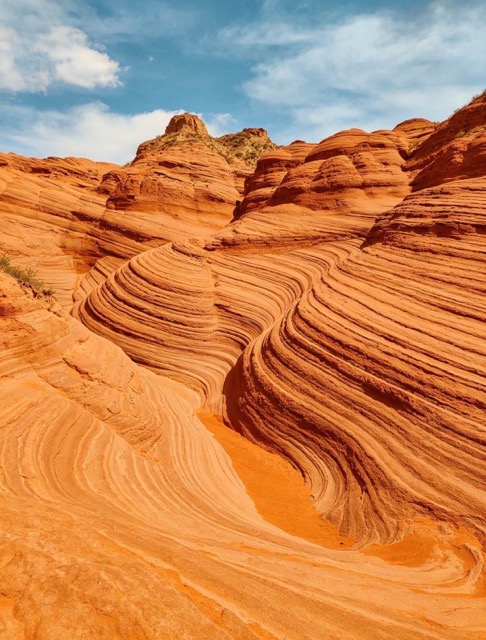
You don't actually need to fly 14 hours to Arizona, then drive another 5 hours into the desert, to stand on a red planet. A hidden spot in Jingbian County, Yulin, Shaanxi Province protects a 96-million-year-old red sandstone masterpiece known as Wave Valley (波浪谷) — a land of wind-carved stone waves, rust-colored canyons, and panoramic desert views so otherworldly they feel like a scene from a sci-fi movie.
For nearly 100 million years, seasonal flash floods and constant desert winds have carved parallel wave textures into the rock — like frozen sea swells, like the fingerprints of time, like a footprint pressed into the surface of Mars. Every sunrise and every sunset paints the canyon in a new palette of ochre, terracotta, and cinnamon.
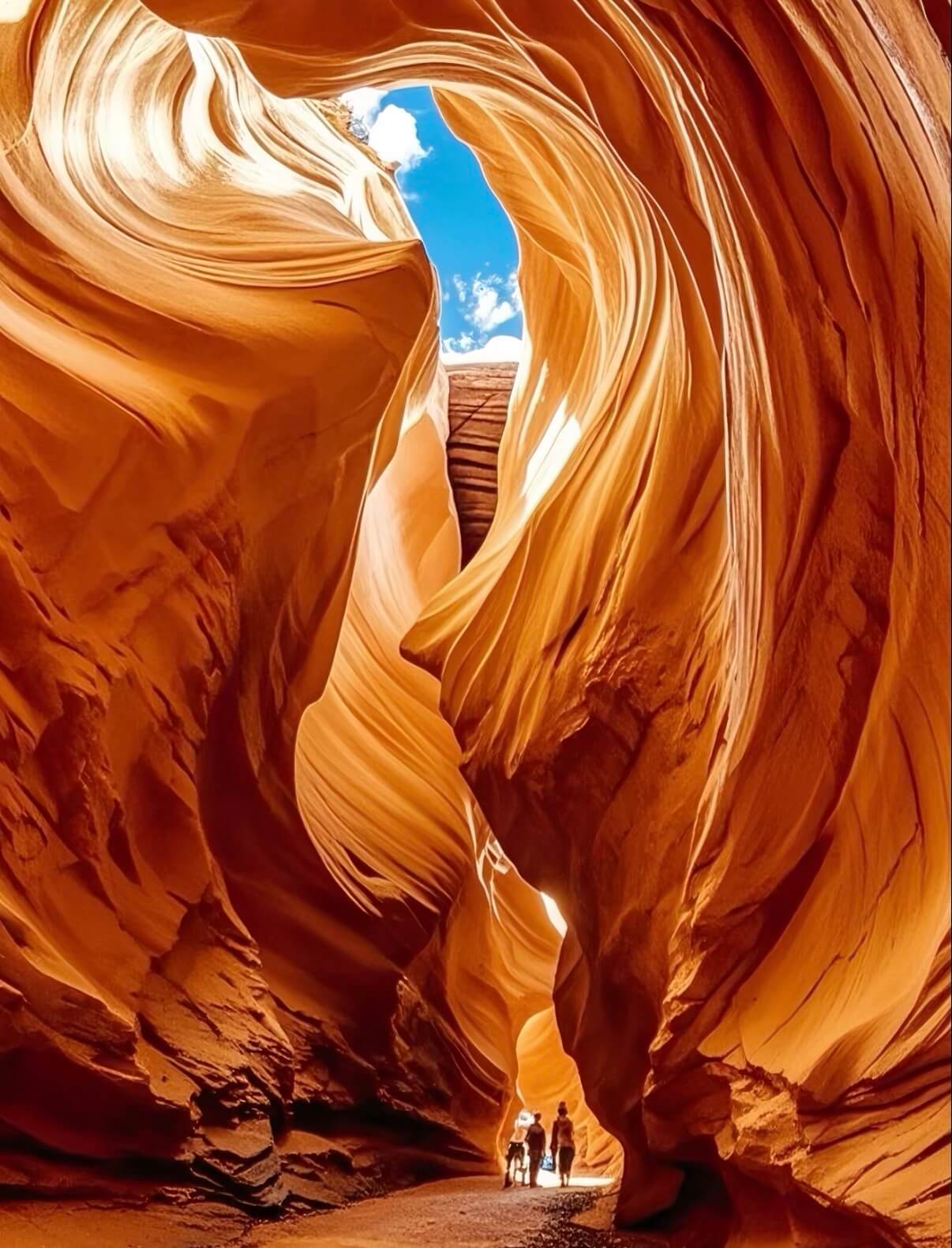
Travelers familiar with the American Southwest will of course say: "This looks like Antelope Canyon." And that instinct is correct — both are breathtaking red sandstone Danxia landscapes, sculpted by the same wind and water forces. But the two destinations actually offer radically different experiences. In a nutshell:
The Short Version
Yulin Wave Valley = a wide, expansive, open-air "Martian landscape gallery" where you can walk on boardwalks for hours above kilometers of undulating red stone.
Antelope Canyon = a narrow, shadowy "underground cathedral of light" where polished walls filter sunlight shafts into a dancing rainbow of color.
If you are planning a China trip and love dramatic canyons, read on for a complete, honest, and practical comparison — no marketing fluff, just the real differences that will decide which one (or both) deserves a spot on your bucket list.
Side-by-Side Comparison: Yulin Wave Valley vs Antelope Canyon
The most useful overview in one glance. Every row answers a practical question travelers actually ask before they book:
| Comparison Item | Yulin Wave Valley, China | Antelope Canyon, USA |
|---|---|---|
| Landform Type | Large-scale open-air Danxia — plateau, cliffs, gullies, and water-level lake-side rock | Deep, narrow slot canyon carved by flash floods into soft Navajo sandstone |
| Feeling / Mood | Open, vast, cinematic — views stretch to the horizon; a wind-swept frontier | Intimate, mysterious — a tight, dark, vertical tunnel of light |
| Sub-scenic Zones | Flame Danxia · Earth-Core Gorge · Red Cliff Danxia · Kilometer Gallery · Water Danxia (lake) | Upper Antelope · Lower Antelope · Canyon X (separate tours & permits) |
| Access & Guide | Open public scenic area — wander freely on boardwalks. No guide required. | Located on Navajo Nation land. Mandatory authorized guided tours only. |
| Pace / Timing | Relaxed. Grand loop: 3–4 hrs; small loop: ~2 hrs. Stay as long as you like. | Strict timed groups. 1–1.5 hrs. Tour guides often rush the line. |
| Peak-Season Ticket | ~¥90 RMB (~$13 USD). Glass bridge / escalator sold separately. | $60–$85 USD per person + mandatory guide fee. Photo permits cost extra. |
| Reservations Needed? | Same-day or next-day tickets are usually easy (except Chinese national holidays). | Must book weeks in advance, especially midday "light-beam" slots. |
| Bags & Equipment | Backpacks, water, tripods are allowed. Boardwalks are stroller-friendly. | No bags allowed. Only phone or camera. No selfie sticks or tripods inside. |
| Best Light | Morning side-light (8–10 AM) and golden hour afternoon reveal 3D wave texture. | Midday 11 AM–1 PM sun beams hit the floor; the "God Light" moment. |
| How to Get There | Fly Beijing → Yulin (~1.5 h) → car/rental to Jingbian (~1.5 h); or train to Jingbian Station. | Fly Phoenix or Las Vegas → 4–5 hour drive to Page, Arizona. |
🌊 Landscape: Wide-Open Vistas vs a Secluded Slot Cathedral
Yulin Wave Valley — The Open-Air Earth Gallery
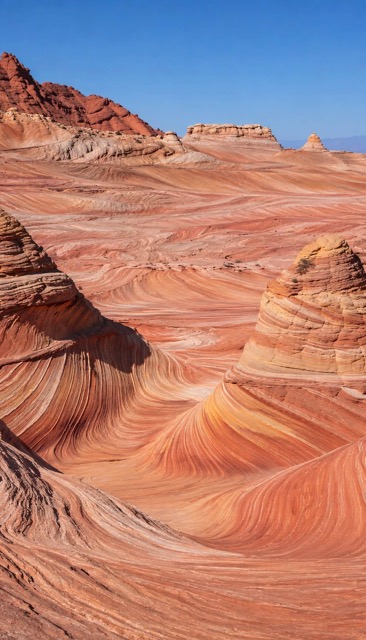
Wave Valley sits on a high desert plateau, and its red sandstone stretches literally as far as the eye can see. The geological footprint is enormous, divided into themed sub-zones — the flaming ridges of Flame Danxia, the narrow crack of the Earth-Core Gorge, a tall red walled amphitheater, a "kilometer-long painter's palette" color zone, and even a section where the red stone flows into a lake.
- • Panoramic & rugged — you stand on top of the landscape and see kilometers of stone waves.
- • Multiple landscapes in one — plateau, cliff, gorge, and waterside.
- • Great for epic wide shots and golden-hour drone photography.
Antelope Canyon — A Light-Beam Cathedral Underground
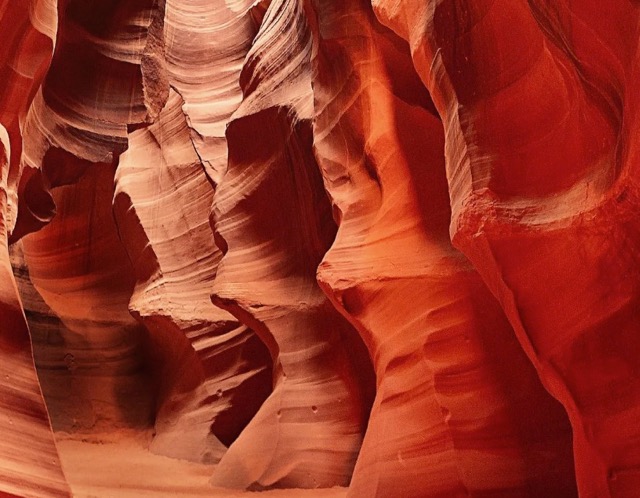
Antelope Canyon is the opposite — a thin, deep slot in the desert. For thousands of years, summer monsoon floods rushed through cracks in soft Navajo sandstone, polishing the walls into silky, flowing curves. What you experience there is not a landscape to walk over, but a space to walk inside.
- • Narrow, vertical, enclosed — walls tower 40 m above but the floor is barely a meter wide in spots.
- • Chasing the light beam — midday sun slants through a top opening and creates a mystical "pillar of heaven" effect.
- • Ultra-smooth texture & rich shadow gradients — ideal for abstract close-up photography.
👣 Experience: Free-Roaming Boardwalks vs Timed Guided Groups
If you ask us which canyon gives you the better vacation pace, the winner is clear.
Yulin Wave Valley
It is an open scenic area managed by local park authorities. You buy a ticket, walk in, and do exactly what you want at your own pace.
- • Grand Loop (大环线) — recommended; 3–4 hours of boardwalk above the most dramatic canyons.
- • Small Loop (小环线) — ~2 hours for time-crunched travelers.
- • Bring a water bottle, a hat, and a camera; no one will rush you to catch the next tour slot.
Antelope Canyon
Because it lies on the sovereign land of the Navajo Nation, the canyon is entirely closed to independent visitors.
- • You must book a Navajo-authorized tour.
- • Tours depart in strictly timed groups, usually lasting about 1–1.5 hours.
- • In peak season, the narrow corridor feels crowded and the guides frequently urge the group forward to make room for the next batch. Many photographers find this frustrating.
💰 Cost & Convenience: Both Have Trade-Offs
The table already gave you a quick snapshot. Here is a more honest, boots-on-the-ground breakdown:
¥ Yulin Wave Valley
-
▸
Base ticket: roughly ¥90 RMB (peak season / ~$13 USD).
-
▸
Add-ons (optional): Glass bridge scenic lift, moving escalator down into the main gorge — budget another ¥50–150 depending on your combo.
-
▸
Queue risk: weekends & National Day (Oct 1–7) produce long lines for escalators & shuttle buses. Start early — arrive before 8 AM if you can.
-
▸
How to get there: Beijing direct flights to Yulin Yuyang Airport are only ~1.5 hours. Rent a car and drive 1.5 h south to Jingbian. You can also take a high-speed or regular train to Jingbian Station and grab a taxi for the last leg.
$ Antelope Canyon
-
▸
Permit + guide: Lower Antelope ~$65–85 USD; Upper Antelope sometimes even higher for "photography tours."
-
▸
Photographer fees (tripods, long exposures) are usually charged separately and require dedicated photo tours (~$200+ for a 2-hour slot).
-
▸
Booking: slots sell out weeks ahead. The highly coveted midday "sunbeam" season (spring / summer) can sell out a month in advance.
-
▸
Restrictions: no bags, no backpacks, no selfie sticks. Only phones and cameras are allowed inside the canyon itself. For independent travelers, this is a real hassle after a long drive.
4 Must-See Spots Inside Yulin Wave Valley
If Antelope Canyon essentially has one star experience (walking the slot + chasing the sunbeam), Wave Valley rewards a slower itinerary with four very different signature views. Give them each 30–60 minutes, and follow our photo tips for the best results.
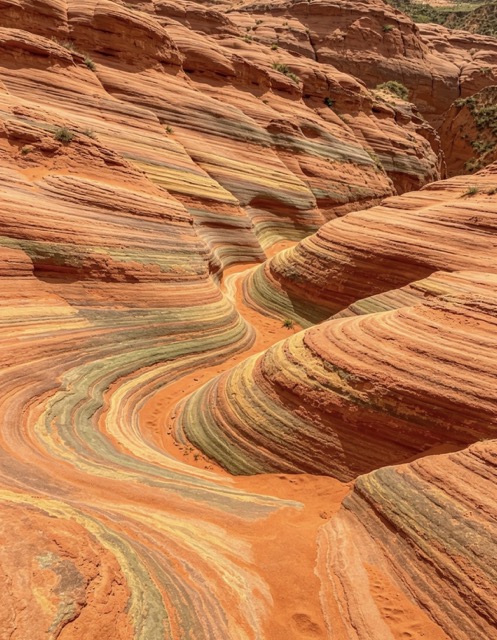
▫️ #1 Flame Danxia (火焰丹霞) — The Iconic Postcard View
Wave Valley's most photographed signature view: undulating ridges of red sandstone that rise and fall in the exact shape of frozen fire. Seen from a high viewpoint, a whole sea of terracotta-colored stone waves rolls to the horizon, and the wind that blows across them actually carries a faint, high whistle — an unforgettable feeling.
📸 Photo tip: shoot in morning front-light (8–10 AM) or afternoon side-light (3–6 PM) for three-dimensional ridges. Midday overhead sun flattens the waves and drains the rich red color.
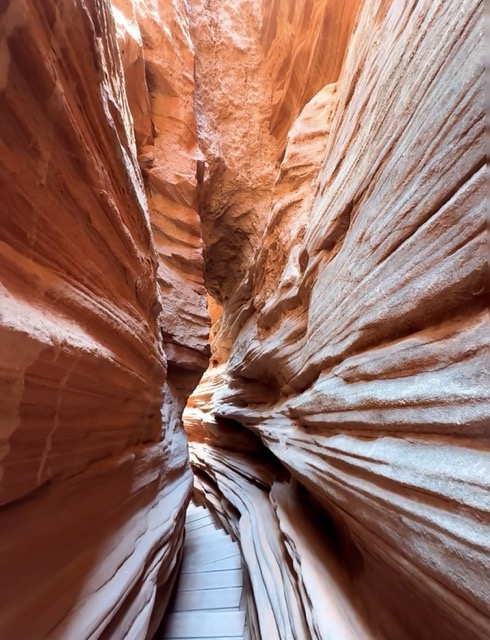
▫️ #2 Earth-Core Gorge · A Line Sky (地心丹霞·一线天) — Feel Like You Are Stepping Into the Earth's Mantle
A deep, knife-edged crack in the red rock; the narrowest spot is barely wide enough for one person. The sheer walls shoot up on both sides, and the light hitting them from the slit above bathes the wave textures in a warm, otherworldly red glow — as though you've literally descended down into the earth's core.
📸 Photo tip: vertical smartphone shots or wide-angle portrait orientation capture the "crushing walls on both sides" drama the best.
▫️ #3 Red Cliff Danxia (赤壁丹霞) — A Towering Red Amphitheater
A massive, precipitous cliff-face of deep rust-red rock. Over thousands of rainy seasons, mineral-rich runoff has streaked the cliff with pale gray and white vertical lines, giving it a weathered, ancient face. A wooden boardwalk hugs the very base of the cliff — walk along it and the red wall presses directly overhead, breathtaking in scale.
📸 Photo tip: shoot from the walkway looking straight up (portrait orientation) to show the cliff's height against the sky, or use a wide-angle at sunset for dramatic silhouettes.
▫️ #4 Kilometer Gallery (千米画廊) — The Painter's Palette of the Earth
Here, the sandstone was laid down in colored bands, one geological age at a time: terracotta, ochre, khaki yellow, and even faint gray-green mineral stripes wind across the stone face like an oil-painting landscape seen from a plane. It's literally a geological cross-section of 96 million years displayed like a wall painting — the name "Kilometer Gallery" couldn't be more perfect.
📸 Photo tip: overcast days (diffused light) actually bring out the different color bands the most evenly, since there are no harsh shadows hiding stripes.
Final Verdict: Which One Should You Visit?
It would be silly to say one is "better" than the other — they aim at totally different travel moods. But we can give you a clear decision rule:
Choose Yulin Wave Valley if you want…
- ✓ A vast, wide-open photography playground with boardwalks you can stroll at your own speed.
- ✓ Four distinct landscapes (flame ridge, gorge, red wall, palette) in a single ticket.
- ✓ A relaxed pace, no mandatory guide, no crowds shoving you to the exit.
- ✓ An extremely affordable price (~¥90) that beats any Utah / Arizona permit.
- ✓ You are already traveling in China (Xi'an, Yan'an, Inner Mongolia) and want an easy day trip or weekend add-on.
Choose Antelope Canyon if you want…
- ✓ A one-of-a-kind, tight-canyon light-beam experience — the "God Light" that Instagram is made of.
- ✓ Silky, abstract, close-up textures and deep shadow gradients.
- ✓ You are already doing a classic American Southwest road trip (Grand Canyon, Zion, Bryce, Monument Valley).
Conclusion
Yulin Wave Valley doesn't try to "replace" Antelope Canyon — the two destinations produce completely different emotions and photographs. But what Wave Valley does deliver, with extraordinary generosity, is a genuine 96-million-year-old Martian landscape at a fraction of the cost, without the flight to America, and without timed groups rushing you through its most beautiful corners.
The next time someone tells you, "You have to go to Arizona to see red sandstone canyons," you can smile and tell them about Jingbian County, Yulin — a quiet corner of northern Shaanxi where wind and water spent 96 million years building a far bigger, and far quieter, red rock masterpiece.
Plan Your Yulin Trip With Wander Any Place
Wave Valley pairs perfectly with Yulin's other top sights: Hongshixia Gorge (塞上碑林), Zhenbeitai Great Wall, and Yulin Ancient City. Combined, they deliver a deep dive into Shaanxi's other history — the frontier. Browse our full Yulin attractions list or contact us for a custom itinerary.
FAQ — Wave Valley vs Antelope Canyon
Q: Is Yulin Wave Valley similar to Antelope Canyon?
A: Both are breathtaking red sandstone (Danxia) landscapes carved by wind and flash floods, but they offer opposite experiences: Yulin Wave Valley is a vast, open-air Martian plateau with panoramic views and multiple themed sub-zones, while Antelope Canyon is a narrow slot canyon famous for shafts of sunlight and polished walls.
Q: How old is Yulin Wave Valley?
A: Wave Valley's red sandstone formations are approximately 96 million years old, formed during the Cretaceous period and carved over millennia by wind erosion and seasonal floodwaters.
Q: Do I need a guided tour to visit Yulin Wave Valley?
A: No. Unlike Antelope Canyon on Navajo land, Yulin Wave Valley is an open scenic area. Visitors can stroll freely along well-built boardwalks. The full Grand Loop (大环线) walk takes 3–4 hours.
Q: How much is the Wave Valley entrance ticket?
A: Peak season admission is around ¥90 RMB per person. Optional extras inside the park (glass bridge, moving escalator) are sold separately. Holidays and weekends can have long queues at paid facilities.
Q: What is the best light for photographing Flame Danxia?
A: Morning light (roughly 8–10 AM, front lighting) and afternoon side light (3–6 PM) render the wave textures the most three-dimensional. Midday overhead sun flattens the relief and washes out the color contrast.
Q: How do I get to Yulin Wave Valley from Beijing?
A: Fly directly from Beijing to Yulin Yuyang Airport (about 1.5 hours), then rent a car and drive roughly 1.5 hours south to Jingbian County. Alternatively take a train to Jingbian Station and use a local taxi.
Q: Can I carry a backpack inside Antelope Canyon?
A: No. Antelope Canyon Navajo tour rules strictly forbid all bags inside the canyon — only a phone or a camera are permitted. This is one major practical difference compared to Yulin Wave Valley, where normal day backpacks, tripods, and water bottles are fine on the boardwalk.
Share this article:
Link copied to clipboard!
No comments yet. Be the first to share your thoughts!